In the fast-paced realm of digital content creation, the choice of editing tools can often feel like navigating a labyrinth of options.
Whether you are a growing influencer managing your personal brand, a performance marketer juggling multiple campaigns, or an e-commerce expert overseeing hundreds of product SKUs, the pressure to produce stunning visuals efficiently is ever-present.
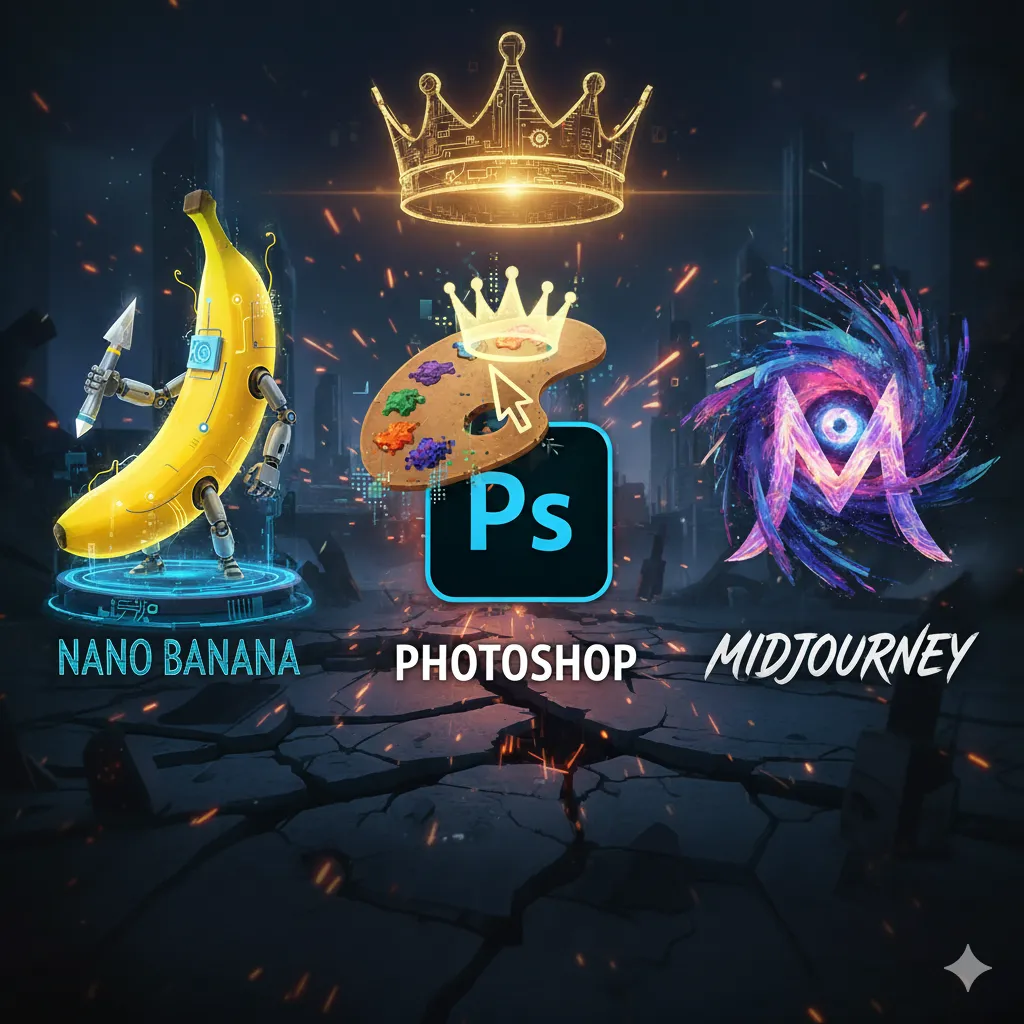
Enter the arena: Nano Banana, a relative newcomer promising effortless image editing and speedy workflows, faces off against the industry giant Adobe Photoshop and the AI powerhouse Midjourney. But who really wins when it comes to practical, real-world editing demands?
Each tool brings its own unique set of capabilities, catering to different user needs. The challenge is to understand not just what these platforms can do in theory, but how they perform under the strain of everyday creative tasks.
This in-depth exploration will dissect the core features, strengths, and pitfalls of Nano Banana, Photoshop, and Midjourney, helping you identify which tool suits your specific workflow — whether you prioritize speed, precision, or AI-driven creativity. Let’s dive in and see which editing tool holds the crown for your needs.
Background & Context
The Reign of Photoshop
For decades, Adobe Photoshop has remained the undisputed king of image editing software. Launched in 1988, Photoshop revolutionized the creative world by offering an extensive toolkit capable of transforming raw images into polished works of art. Its appeal lies in its precision and versatility, trusted by photographers, graphic designers, advertising agencies, and publishers worldwide. Photoshop’s rich feature set — including advanced masking, multi-layer control, color grading, and typography tools — allows professional editors to manipulate images with meticulous detail. Its support for RAW file workflows and color management ensures photographers retain the highest image quality from lens to output.
Despite its power, Photoshop’s complexity and sometimes steep learning curve pose challenges for new users or those seeking quick fixes. Its resource-heavy installation also demands capable hardware, which may not suit every content creator’s setup.
The Rise of AI-Driven Visual Generation: Midjourney
The AI wave has swept through many creative industries, and image editing is no exception. Midjourney represents a new breed of platforms that leverage artificial intelligence to create images entirely from text prompts. As a creative AI generator studio, Midjourney excels in generating multiple visual concepts rapidly, empowering users—especially tech enthusiasts, AI educators, and marketers—to produce fresh, diverse imagery that captures audience imagination.
Unlike traditional editors, Midjourney’s strength lies in generating ideas and visual assets “from scratch” rather than editing existing images post-capture. However, its AI-driven approach sometimes presents creative control challenges, with brand consistency and specific design requirements difficult to maintain. Nonetheless, it is a powerful tool for ideation and batch asset generation.
The Newcomer: Nano Banana
Stepping into this landscape is Nano Banana, an emerging AI-powered image editor designed for ease and speed. Unlike Photoshop’s vast complexity and Midjourney’s generation-centric approach, Nano Banana focuses on simplifying everyday editing for small businesses, solo founders, and marketing teams pressed for time.
Nano Banana touts features such as auto-resize, instant background removal, and on-brand template application, aimed at streamlining the process of creating marketing assets across social media and ads. Its interface is designed to be intuitive, minimizing learning curves, and it integrates seamlessly with marketing AI institutes to optimize your content strategy dynamically.
This newcomer’s proposition is compelling: make image editing accessible and efficient without sacrificing quality — but can it really rival the well-established giants?
Core Benefits or Key Features
Nano Banana
- Simplicity & Speed: With its AI-enhanced backend, Nano Banana automates common tasks like resizing images for social media formats, removing backgrounds quickly, and applying branded templates to maintain visual consistency.
- User-Friendly Interface: Intuitive design means that non-designers and busy entrepreneurs can achieve polished visuals without extensive training.
- Integration with Marketing AI Institutes: Tailored for marketing workflows, Nano Banana predicts trending content attributes and integrates with broader AI marketing ecosystems, helping users optimize content distribution and targeting.
- Collaboration & Versioning: Designed with creative operations teams in mind, Nano Banana offers collaborative editing and version history to streamline group workflows.
Photoshop
- Precision Editing: Photoshop’s strength lies in its granular control — precise masking, layer manipulation, adjustment layers, and advanced selection tools let users fine-tune every pixel.
- Non-Destructive Workflow: Edits do not overwrite original images, allowing for iterative adjustments without data loss.
- RAW Format Support: Critical for professional photographers who require highest-quality workflows straight from camera files.
- Professional Color Management: Ensures brand-safe color reproduction, essential for print and digital consistency.
- Comprehensive Toolset: Includes filters, typography controls, 3D editing, video editing capabilities, and extensive plugin support.
- Steep Learning Curve: Learning to master Photoshop requires time and dedication, which may hinder quick turnaround projects.
Midjourney
- AI-Driven Image Generation: Converts simple language prompts to stunning visuals, accelerating idea generation.
- Batch Generation & Variations: Generates multiple image options real-time, allowing rapid feedback and selection.
- Creative Exploration: Inspires new visual directions that traditional editors might overlook.
- Limitations in Control: While great for ideation, Midjourney may miss the mark on fine-tuning and brand alignment.
- Community & Collaboration: Active user and prompt-sharing communities enrich creativity and support users.
Practical Applications
How do these tools perform in real-world scenarios? Let’s break down where each shines.
Content Creators
For social media managers, influencers, and content creators who frequently publish image-based posts, speed and ease of use are paramount. Nano Banana’s auto-resize and background removal prove invaluable for adapting images across Facebook, Instagram, TikTok, and LinkedIn with minimal effort. The ability to deploy templates branded to your style guides also ensures consistent presentation without requiring advanced design skills.
Midjourney serves as an ideation tool in this space, generating fresh visual concepts from simple prompts that creators can then refine or repurpose.
Photoshop may be overkill for routine posts but remains indispensable when custom retouching, composite images, or high-res content is required.
Performance Marketers
Marketers running paid campaigns often need pixel-perfect visuals optimized for conversions. Photoshop’s precision tools enable them to craft brand-safe digital assets, adjusting contrast, sharpness, and text overlays to increase click-through rates (CTR) and reduce cost per acquisition (CPA). Its non-destructive editing workflow ensures assets can be revised quickly amid campaign changes.
Nano Banana can speed up simpler marketing-level edits but may lack Photoshop’s advanced toolkit to meet complex brand requirements.
Midjourney can supply innovative visuals to differentiate campaigns but may require integration with Photoshop or Nano Banana to polish final materials.
E-commerce Teams
Maintaining consistent, high-quality product imagery at scale is tough. Midjourney’s batch editing and AI-driven object removal can help keep SKU images uniform and professional by generating multiple background-free product shots and removing distracting elements efficiently.
Photoshop’s detail-oriented retouching tools are useful for ensuring image fidelity, handling fine artifact corrections and shadow controls.
Nano Banana’s quick background removal and resizing help prepare images faster but might struggle with high-precision demands of large online catalogs.
Photographers & Retouchers
For photographers seeking unmatched quality control, Photoshop remains unsurpassed. Features like super-resolution, artifact reduction, and RAW editing preserve image fidelity. Its extensive color management ensures print and digital consistency, critical for professional portfolios and client work.
While Nano Banana offers simplicity, it primarily targets smaller scale edits rather than professional photo retouching. Midjourney’s generation abilities cannot yet replicate photographic realism or nuanced detail adjustments.
Creative Operations Leads & Teams
Managing creative workflows with multiple contributors can be complex. Nano Banana’s collaboration tools, versioning history, and predictive editing suggestions aim to streamline team processes and reduce bottlenecks.
Photoshop supports collaboration through Adobe Creative Cloud sharing but requires user expertise.
Midjourney enables brainstorming within teams, facilitating parallel idea generation with rapid iterations.
Challenges or Controversies
No tool is perfect. Understanding limitations helps set realistic expectations.
Nano Banana
- Feature Limitations: While easy to use, Nano Banana lacks some advanced features critical for professional-level editing — such as detailed retouching, curve adjustments, or precise masking.
- New Market Entrant: Being newer means fewer integrations, plugins, or community resources compared to Photoshop or Midjourney.
- Reliance on AI Templates: May risk templated designs, reducing uniqueness over time.
Midjourney
- Creative Control: Generates impressive imagery but editing those images post-generation can be cumbersome or impossible within the platform.
- Brand Consistency Issues: Automated generation sometimes produces off-brand visuals, which require manual vetting.
- Intellectual Property Concerns: As with many AI image generators, copyright and originality debates remain active.
Photoshop
- Steep Learning Curve: Users need time investment to become proficient, limiting accessibility.
- Resource-Intensive: Requires powerful hardware to function smoothly.
- Overwhelming Feature Set: For quick or casual edits, Photoshop can be unnecessarily complex and slow compared to lightweight tools.
Expert Tips & Insights
Navigating these platforms efficiently requires strategy:
- Start Simple: If you’re new or need rapid edits, begin with Nano Banana to build confidence and speed.
- Scale Up Precision: For detailed, brand-critical work, transition to Photoshop’s powerful, exacting controls.
- Leverage AI for Creativity: Use Midjourney to fuel ideation cycles, generating variants and creative inputs that break the mold.
- Define Your Goals: Clearly outline your editing priorities—speed, creativity, detail—before committing to a platform.
- Combine Tools: Don’t hesitate to incorporate multiple tools in your workflow; for example, create concepts with Midjourney, refine with Photoshop, and automate batch resizing in Nano Banana.
- Keep Learning: Stay updated on emerging AI enhancements in Photoshop and Nano Banana to future-proof your workflows.
Future Outlook
The future of image editing is merging AI innovation with traditional precision. Nano Banana’s trajectory suggests growing emphasis on user-friendly AI-powered features, potentially bridging the gap between casual users and professionals. Photoshop is expected to embed deeper AI capabilities, such as intelligent masking and auto-enhancements, while preserving full manual control. Midjourney will likely advance its language prompt systems to allow tighter creative direction and brand compliance.
As these platforms evolve, creatives can anticipate increasingly fluid workflows where AI assists but does not replace human intuition and expertise.
For a deeper dive into how AI is transforming creative processes, check out this insightful article on AI-powered search.
Conclusion & Takeaway
The battle between Nano Banana, Photoshop, and Midjourney reflects the diversity of modern creative demands. There is no one-size-fits-all winner. Instead, success lies in choosing the right tool aligned with your needs:
- Choose Nano Banana if you prioritize quick, hassle-free edits that integrate easily with marketing workflows.
- Opt for Photoshop when precision, depth, and professional-grade editing are paramount.
- Embrace Midjourney if your focus is high-volume, AI-driven image generation and creative experimentation.
By understanding each platform’s strengths and weaknesses, you can craft workflows that enhance productivity, enable creative freedom, and ensure visually compelling results across all your digital content.
Begin by experimenting with one or a combination of these tools, and watch your creative capabilities soar in this exciting era of AI-enhanced imagery.